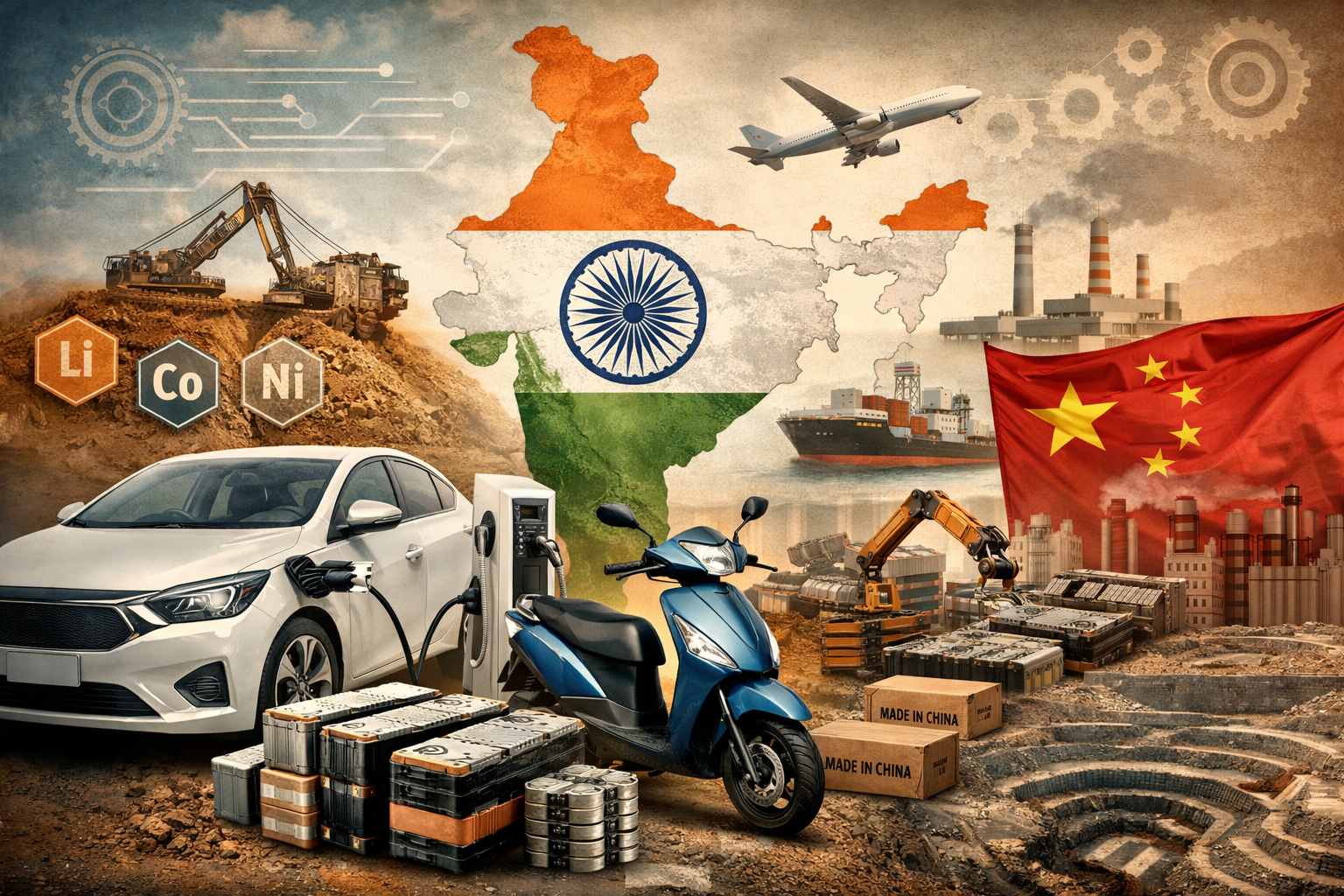
India’s EV Boom and the Value Chain Risk
India’s electric vehicle (EV) transition is increasingly presented as a demand-side success that has crossed the point of no return. In just five to six years, EV penetration has risen from roughly 0.5% in 2019-20 to over 6% in 2024-25, with annual sales now exceeding 1.5 million units. Policy incentives, improving total cost of ownership, and a steadily maturing charging and financing ecosystem have combined to push EVs into the mainstream.
That narrative is broadly correct. India is no longer debating whether EVs will scale, but how fast. Yet beneath the headline numbers lies a more consequential question that will shape the next decade of mobility, manufacturing, and investment: who controls the resources, technologies, and intermediate manufacturing that underpin this transition?
The central risk facing India’s EV journey today is not consumer adoption, technology readiness, or charging availability. It is a strategic dependence. Without sovereignty over critical minerals, battery materials, and high-value components, India risks building a clean mobility future on foundations it does not own.
Rapid adoption, fragile underpinnings
India’s EV adoption has been unusually swift. In less than a decade, EVs have moved from experimental pilots to a meaningful share of two-wheelers, three-wheelers, and urban fleets. Projections suggest annual EV sales could rise to 20–22 million units by 2035 if current momentum continues.
Three forces have driven this expansion.
First, economics. In high-utilisation segments such as last-mile delivery, shared mobility, and commercial three-wheelers, EVs are already cost-competitive with internal combustion engine vehicles on a lifecycle basis.
Second, policy support. Central and state incentives, tax concessions and schemes such as FAME have lowered upfront barriers and encouraged OEM participation.
Third, ecosystem development. Charging infrastructure, battery leasing, fleet-management software, and financing innovations have reduced operational friction.
Yet this growth rests on supply chains that remain largely external. Batteries, motors, and power electronics, the heart of the Ev, depend heavily on imported raw materials and components. Much of the value creation occurs outside India, leaving domestic manufacturers exposed to price volatility, supply disruptions, and geopolitical risk.
The raw-material fault line
At the upstream end of the EV supply chain sit critical minerals: lithium, cobalt, nickel, manganese, and rare earth elements such as neodymium and dysprosium. These materials are essential for lithium-ion batteries and permanent magnet motors. India currently imports nearly all of them.
The vulnerability is not only about where minerals are mined, but where they are processed. While lithium may be sourced from Australia or South America and cobalt from Africa, China dominates the refining and processing stage, controlling roughly 70–80 per cent of global lithium and cobalt refining and close to 90 per cent of rare earth magnet production in rounded terms. Processing dominance translates directly into pricing power and supply leverage.
Recent export controls and policy signals around critical minerals and rare earths have shown how quickly geopolitics can spill into industrial supply chains. For an EV ecosystem still scaling and operating on thin margins, such shocks can delay investments, disrupt production schedules, and undermine cost competitiveness.
Without a coherent raw-materials strategy, India risks replacing dependence on imported crude oil with dependence on imported battery materials, arguably a more concentrated and less forgiving supply landscape.
The missing middle of India’s EV ecosystem
Even if upstream access is secured, India faces a deeper structural challenge: the weakness of its midstream manufacturing layer.
Much of today’s EV industry operates on an assembly-led model. Cells, magnet materials, and key electronic sub-systems are imported, assembled locally, and integrated into final vehicles. This approach enables speed, but limits domestic value addition, learning, and pricing control.
The government’s Production Linked Incentive scheme for Advanced Chemistry Cell manufacturing was intended to address this gap. The programme targets 50 GWh of domestic ACC capacity, with around 40 GWh awarded to four firms. However, as of late 2025, only about 1 GWh of capacity has actually been installed, despite several years of announcements and commitments.
This gap between intent and execution highlights how difficult battery manufacturing really is. It is capital-intensive, technologically complex, and unforgiving of inefficiency. Countries that dominate this space did not get there through assembly alone.
For downstream players, OEMs, tyre manufacturers, fleet operators, and mobility service providers, this matters directly. Weak domestic midstream capability means higher exposure to cost swings, less pricing predictability, and limited localisation benefits across the vehicle ecosystem.
R&D gaps and the cost of late entry
India’s challenges are not only industrial, but technological. Historically, investment in battery R&D has been modest relative to global leaders. As a result, India enters large-scale lithium-ion manufacturing at a time when incumbents already enjoy advantages in scale, intellectual property, and tightly integrated supply chains.
Competing purely on cost will be difficult. Yet the opportunity is not closed. There remains scope to adapt chemistries and manufacturing processes to India’s climate, duty cycles, and affordability constraints.
More importantly, the global industry is already looking beyond conventional lithium-ion. Sodium-ion and solid-state batteries offer India a chance to engage earlier in the technology curve rather than perpetually catching up.
Technology as a lever for resource security
The rise of lithium iron phosphate batteries illustrates how technology choices can reshape resource dependence. LFP’s global share has surged over the past four years, largely because it reduces reliance on cobalt and nickel, two metals associated with supply concentration and volatility.
For India, this is a strategic lesson. Resource constraints are not destiny. Policy, standards, and incentives can be designed to encourage chemistries and designs that align with domestic realities and reduce exposure to the most constrained minerals.
From EV adoption to EV sovereignty
India’s EV transition has decisively moved beyond the question of adoption. The next phase must focus on sovereignty across the value chain: securing mineral access, building domestic refining and cell manufacturing, investing in advanced R&D, and embedding recycling and circularity from the outset.
This is not a one-budget-cycle project. Building a resilient, integrated EV ecosystem typically takes 10–15 years. The decisions taken in the next five years will determine whether India becomes a price maker or remains a price taker in the global EV economy.
A moment of choice
India now faces two paths. One leads to rapid EV adoption built on external supply chains and imported value. The other leads to a more resilient, strategically autonomous EV ecosystem, built patiently but deliberately.
EV adoption is the visible headline. EV sovereignty is the story that will decide whether India merely participates in the global transition or helps shape it. The choices policymakers, OEMs, and investors make today will lock in that path for the next generation of mobility.