Supply Chain Bottlenecks May Slow EV Penetration in India by 2030
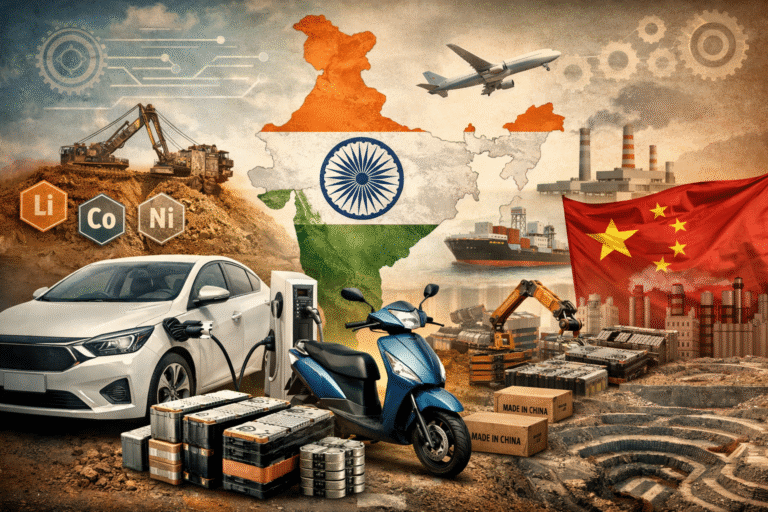
EV supply chain bottlenecks could significantly delay India’s electric vehicle penetration targets for 2030, even as demand and policy support continue to grow, according to an industry analysis reported by Cartoq.
The report highlights that shortages across key components such as battery cells, critical minerals, power electronics, and semiconductors remain major challenges for India’s EV ecosystem. While vehicle demand is rising steadily across two-wheelers, passenger cars, and commercial segments, production capacity is struggling to keep pace due to global and domestic supply limitations.
Battery supply remains the most critical concern. India is still heavily dependent on imports for lithium-ion cells and essential raw materials like lithium, cobalt, and nickel. Any disruption in global supply chains or geopolitical instability can directly affect EV production timelines and pricing, slowing adoption rates.
Semiconductor availability is another constraint, particularly for advanced driver systems, battery management systems, and vehicle control units. Although chip shortages have eased compared to earlier years, EVs require higher semiconductor content than conventional vehicles, keeping pressure on suppliers.
The report also points to infrastructure readiness and localisation challenges. While government initiatives such as PLI schemes and battery manufacturing incentives aim to strengthen domestic production, large-scale localisation will take time to stabilise costs and ensure consistent supply.
As a result, industry experts warn that without faster progress in domestic manufacturing and supply chain resilience, India may fall short of its aggressive EV penetration goals by the end of the decade.
Editor’s View
The discussion around EV supply chain bottlenecks is a timely reminder that electrification is not driven by demand alone. Even with strong consumer interest and government incentives, supply chain readiness ultimately decides how fast EV adoption can scale.
For the tyre industry, this matters more than it may appear at first glance. Slower EV penetration directly impacts demand for EV-specific tyres, which are designed for higher torque loads, heavier vehicles, and lower rolling resistance. If EV volumes grow unevenly due to supply constraints, tyre manufacturers may need to balance investments between conventional and EV-focused product lines more carefully.
At the same time, localisation efforts across batteries, electronics, and components will gradually stabilise the EV ecosystem. As domestic manufacturing improves, EV production volumes are likely to rise sharply, creating long-term opportunities for tyre makers prepared with the right technologies.
In short, supply chain bottlenecks may slow the journey, but they do not change the destination. For the tyre sector, readiness and flexibility will be key as India’s EV transition unfolds in phases rather than all at once.